Agentic Engineering: The Next Level After Vibe Coding
If you've ever typed a description of an app into an AI tool and watched it build something for you, you've already tried a version of what people call vibe coding. The term describes building software by telling an AI what you want in plain, everyday language instead of writing code yourself. Agentic engineering is the next step: AI agents, programs that can plan, write and test parts of an app on their own, do the building while you direct, review and correct their work.
Andrej Karpathy, an OpenAI co-founder and former head of AI at Tesla, coined vibe coding in February 2025 and proposed the name agentic engineering in February 2026, about a year later. In his post on X, he said many people had tried to find a better name for this way of working to set it apart from vibe coding, and that agentic engineering was his current favorite.
What agentic engineering means
Agentic engineering means spending most of your time directing and checking the AI's work rather than doing that work yourself. Karpathy explained the two halves of the name separately. He described the new default as one where "you are not writing the code directly 99 percent of the time." Instead, you orchestrate agents that do the writing and act as oversight. He chose "engineering" to signal that there is an art, a science and expertise to doing this well, and that it is a skill you can learn and get better at.
This is a little different from how vibe coding was first described. In Karpathy's original framing, vibe coding meant giving in to the vibes and trusting what the AI produced without checking every detail closely. Agentic engineering still has the AI doing most of the writing, but it puts more of the responsibility back on you: deciding what to build, checking whether the AI got it right and figuring out what to fix.
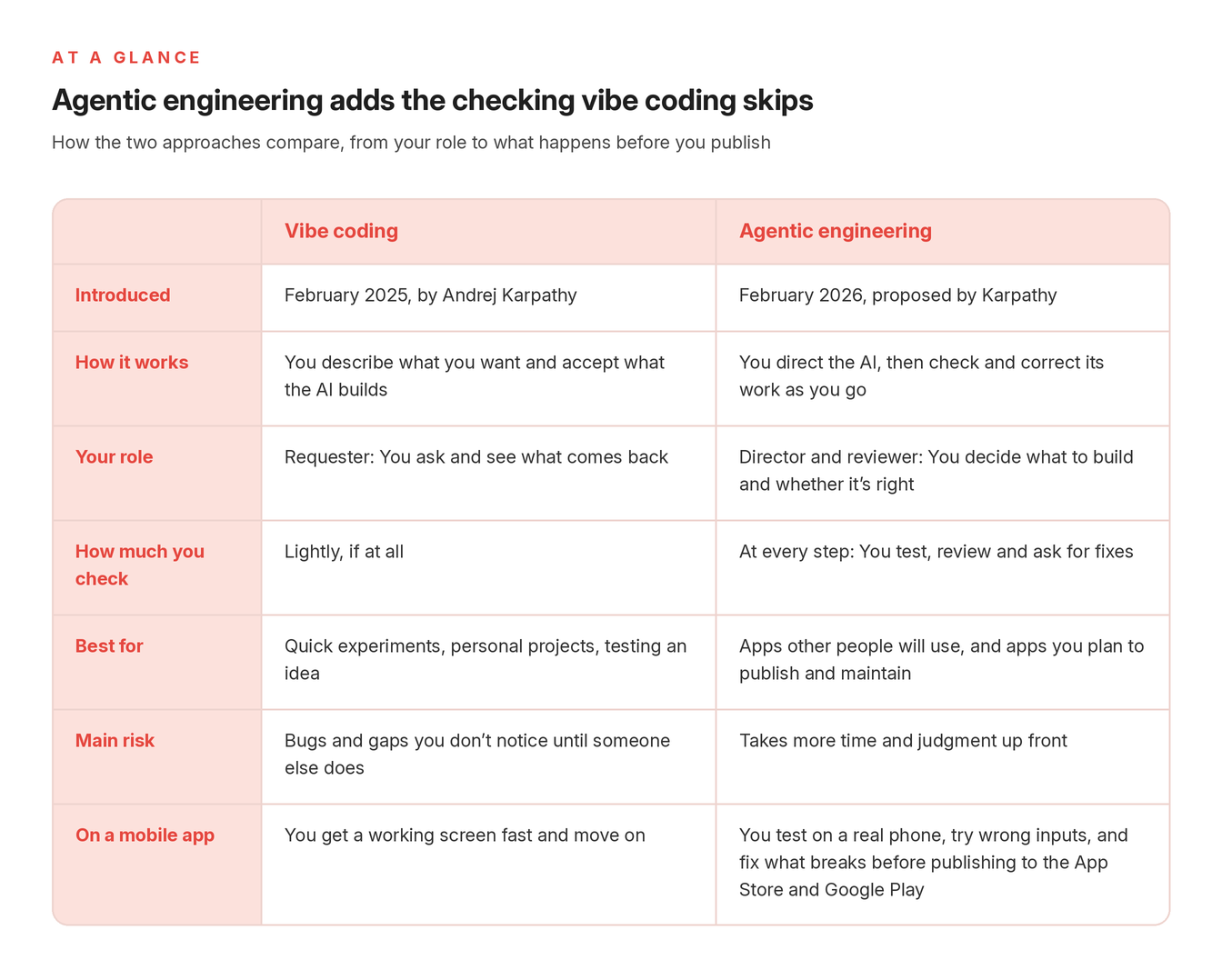
Karpathy was describing how professional developers work. The same idea applies to anyone building an app with AI, including people with no coding background, because directing the AI, testing the result and deciding what to fix depend on knowing what the app should do and who it's for, and that knowledge comes from the person with the idea. Here is how the two approaches compare.
Why agentic engineering matters when you're building a real app
A casual, hands-off approach works fine for testing an idea for fun, something only you will ever see. It matters more once other people will use what you build, once user data is involved, or once you plan to publish the app to the App Store and Google Play. At that point, checking the AI's work and fixing what's off is part of how you build, and agentic engineering is the practice of building that into every step.
On Thunkable, for instance, a few tools support this kind of checking and correcting. Discuss Mode lets you keep talking with the AI about changes in one ongoing conversation instead of starting over with a new request each time. App Testing lets you try the app on your own phone right away instead of only looking at a preview. The Code Editor lets you step in and fix something yourself when a request to the AI doesn't get it quite right. Versioning lets you roll back to an earlier version if a change makes things worse. Together, they support the describe, check and fix loop that agentic engineering involves, for an app you can publish to the App Store and Google Play rather than a demo in a browser.
The skill that matters more now
When an AI is doing the writing, the important skill shifts from writing code yourself to recognizing what a good result looks like and noticing when something is off. This is the engineering half of the name: the art, science and expertise Karpathy pointed to is knowing what to build, how to check it and when to ask for a change. It's a different skill than memorizing the rules of a programming language, and it isn't automatically easier.
Say the AI builds you a screen. You still have to look at it and ask: Does this do what I wanted? Would someone using this app understand what to do here? Does this match how I pictured it working? Answering those questions takes the same kind of judgment a developer used to build up by writing code themselves, just used at a different point in the process.
This is why checking the AI's work matters as much as asking for it in the first place. The AI gives you a fast first attempt. You decide whether it's good and what needs to change.
Agentic engineering for teams
This way of working applies as well to a small team as it does to one person working alone with an AI. A non-technical founder can describe what needs to change, while a teammate who knows how to code can review the output more closely. Both do the describe, check and fix work, from different angles.
On Thunkable, for instance, a team can work on one project through an Organization, one editor at a time. One person describes a feature and lets the AI build it, then a teammate who knows how to code opens the Code Editor to check or adjust how it works.
The takeaway
Vibe coding is what got a lot of people's attention. Agentic engineering is closer to what works once you're building something you plan to keep, publish and maintain. That means staying involved: checking the AI's work, testing it and fixing what needs fixing, instead of generating something fast and hoping it holds up. As Webbit21 put it, "It's not just about building fast but how easy it is to maintain the application."
Start building free on Thunkable, then publish to the App Store and Google Play when your app is ready. Publishing to the stores requires a Builder or Advanced plan.

View Pricing
If you’re an administrator or requesting multiple licenses for your school or district, our team will follow up with you directly to learn more and help set up the right Education plan. We’ll work with you to make sure Thunkable is the best fit for your districts/classrooms.
We also offer special discounts for individual students and educators. Apply below, and you’ll receive a promo code via email to claim your discounted Thunkable Education plan.


Related Resources
Agentic Engineering: The Next Level After Vibe Coding


Thunkable vs the top AI app builders: which one actually gets your app into the App Store?

True Native Apps vs. Progressive Web Apps: The Difference For Developers and Their Users
Start
Creating
Creating



Your idea can be live today.